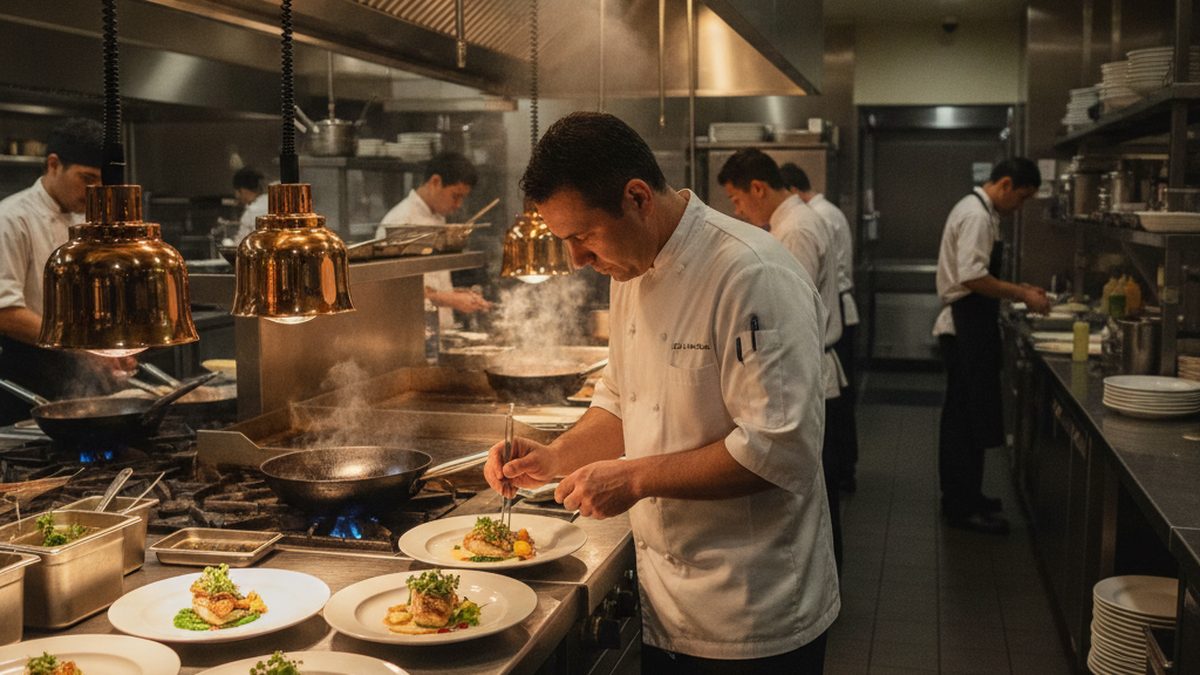
A restaurant is one of the hardest small businesses to insure well. You have hot oil, sharp knives, wet floors, alcohol, delivery drivers, high staff turnover, expensive equipment and inventory that spoils in a few hours without power.
I’m Shalom Samya, a licensed commercial insurance broker based in Tarzana. I work with restaurants, cafés, bars, food trucks and caterers across Los Angeles and the San Fernando Valley. This guide covers what restaurant insurance in California actually needs to include, where owners get caught short, and what landlords, event organizers and delivery platforms usually ask for.
It’s written for owners and operators, not insurance people. Plain English, no filler.
Why Restaurant Insurance in California Is Different
Food and beverage businesses combine several risk types that most other businesses only face one at a time. A dental office has liability exposure. A warehouse has property exposure. A restaurant has all of it, every shift.
California adds its own layers. Workers’ comp is mandatory with even one employee. Employment rules are stricter than in most states. Liquor is regulated by the Department of Alcoholic Beverage Control (ABC). And in Los Angeles, rents are high enough that most landlords write detailed insurance requirements into the lease.
The risks I see most in LA food businesses
- Employee injuries: burns, cuts, slips on wet floors, back strains from lifting, and repetitive stress from prep work.
- Customer injuries: slip-and-falls, foodborne illness, allergic reactions, broken glass, hot beverage spills.
- Alcohol-related claims: fights, service to minors, and injuries that happen after a guest leaves.
- Property losses: kitchen fires, water damage, walk-in cooler failures and theft.
- Shutdowns: a fire, a utility outage or damage next door can close you for weeks while rent and payroll keep running.
- Employment claims: harassment, discrimination and wrongful termination, driven by turnover and a young workforce.
- Delivery and catering driving: staff using their own cars for your business.
- Cyber and payment fraud: POS systems, online ordering and stored customer data.
Each of those maps to a different policy. The goal is to cover all of them without buying the same protection twice.
Coverage by Venue Type
Not every food business needs the same program. A coffee cart and a full-service cocktail bar have very different exposures. Here’s how I typically think about it. Treat this as a starting point, not a final answer, because your lease, contracts and operations will change the picture.
| Coverage |
Full-service restaurant |
Café / coffee shop |
Bar / nightclub |
Food truck |
Caterer |
| Workers’ compensation |
Required (with employees) |
Required (with employees) |
Required (with employees) |
Required (with employees) |
Required (with employees) |
| General liability |
Core |
Core |
Core |
Core |
Core |
| Liquor liability |
If serving alcohol |
Rarely (unless beer/wine) |
Core |
Usually not |
If serving or bartending |
| Property / equipment |
Core |
Core |
Core |
Inland marine or auto physical damage |
Equipment floater |
| Equipment breakdown and spoilage |
Strongly recommended |
Recommended |
Recommended |
Recommended |
Recommended |
| Business income |
Strongly recommended |
Recommended |
Strongly recommended |
Recommended |
Recommended |
| Commercial auto |
If you own vehicles |
If you own vehicles |
If you own vehicles |
Core |
Core if you own vans |
| Hired and non-owned auto |
If staff deliver or run errands |
If staff run errands |
Recommended |
Recommended |
Strongly recommended |
| EPLI |
Strongly recommended |
Recommended |
Strongly recommended |
Recommended with staff |
Recommended |
| Cyber liability |
Recommended |
Recommended |
Recommended |
Consider |
Consider |
| Umbrella / excess |
Recommended |
Optional |
Strongly recommended |
Optional |
Often required by venues |
Many carriers package general liability, property and business income into a Business Owner’s Policy (BOP) built for restaurants. For smaller cafés and quick-service spots, that’s often the most efficient structure. Larger operations and bars with heavy alcohol sales usually need separate, stand-alone policies.
Workers’ Compensation for Restaurants
Under California Labor Code §3700, virtually every employer with even one employee must carry workers’ compensation. That includes part-time dishwashers, weekend servers and family members on payroll in most cases. Operating without it is a crime, and the Labor Commissioner can issue stop orders that shut you down and assess penalties.
Kitchens produce a steady stream of claims. Burns, knife cuts, slips and lifting injuries are common. Cal/OSHA also has an indoor heat illness standard that applies to hot workplaces like commercial kitchens, which is worth reviewing with your team. For the full picture on how comp works in the state, see my guide to workers’ compensation in California.
How restaurant comp is priced
California workers’ comp is priced per $100 of payroll, by class code. The Workers’ Compensation Insurance Rating Bureau (WCIRB) publishes advisory pure premium rates, and each carrier files its own rates on top of that.
Most restaurant staff fall under the main restaurant classification (9079 in California). Other codes can apply depending on what you actually do, such as catering, bakery production or separate clerical staff. Getting the classification right matters, because a wrong code can mean overpaying or a surprise bill at audit.
Once your premium passes the eligibility threshold, an experience modification factor applies. A clean claims history can lower your rate over time. A string of claims will raise it.
The payroll audit problem with high turnover
Restaurant comp policies are written on estimated payroll and then audited after the policy year ends. With high turnover, seasonal hiring and fluctuating hours, estimates are often wrong.
The mistake I see most often is an owner who underestimates payroll to lower the upfront premium, then gets a large audit bill a year later. I’d rather set a realistic estimate and adjust mid-term if the business grows. Some carriers offer pay-as-you-go comp tied to your payroll service, which can smooth this out.
Tips and payroll
How tips are treated for comp payroll can vary, so ask your broker how your carrier handles reported tips versus wages. Keep clean records that separate them. Auditors will ask.
General Liability
General liability insurance covers bodily injury and property damage to third parties. For a restaurant, that means a customer who slips near the restroom, a guest who gets sick after a meal, or a server who spills hot soup on someone.
It also typically includes products-completed operations coverage, which is what responds to foodborne illness claims, and personal and advertising injury.
What to check in a restaurant GL policy
- Limits: $1 million per occurrence and $2 million aggregate is the common baseline. Many leases require exactly that.
- Per-location aggregate: if you have more than one location, ask for the aggregate to apply per location so one bad year at one store doesn’t drain coverage for the others.
- Additional insured endorsements: landlords, property managers and event organizers will want to be named. Make sure the endorsement form matches what the contract asks for.
- Assault and battery exclusions: common in bar and nightclub policies. More on that below.
- Food contamination: GL covers injury claims, but not your own lost revenue from a contamination shutdown. That’s a separate endorsement.
Liquor Liability Insurance in California
If you sell or serve alcohol, you need liquor liability insurance in California. Standard GL policies usually exclude liability for businesses “engaged in the business” of selling alcohol, which means a restaurant with a beer-and-wine license is outside that GL coverage for alcohol claims.
The California ABC issues the licenses. It doesn’t mandate liquor liability insurance for most license types, but your landlord almost certainly will. So will event venues, and so will many lenders.
California’s dram shop rules, briefly
California gives licensed sellers more protection than many states. In general, a licensee is not liable for injuries caused by an intoxicated adult customer. The major exception is serving alcohol to an obviously intoxicated minor, which can create liability.
That doesn’t make the coverage unnecessary. Claims still get filed, defense costs are real even when you win, and liquor policies also respond to allegations around service to minors, over-service claims that get pleaded creatively, and injuries on your premises connected to drinking. Laws and court interpretations change, so don’t rely on the statute as your only protection.
Assault and battery exclusions
This is the part bar owners most need to read. Many liquor and GL policies for bars exclude or sharply limit claims arising from assault and battery. That includes fights between patrons and, in some policies, claims involving your own security staff.
For a bar or nightclub, a fight is one of the most likely claims you’ll ever face. If your policy excludes it, you’re uninsured for your biggest risk. Some carriers offer assault and battery coverage with a sublimit, such as $100,000 or $250,000. I push for that coverage for any venue with late hours, a dance floor or door staff.
Rating and cost factors
Liquor liability is usually rated on alcohol sales. The ratio of alcohol to food sales matters a lot. A restaurant where alcohol is 20% of sales is viewed very differently from a bar where it’s 70%.
Other factors include closing time, entertainment, capacity, security staffing, whether you do bottle service, and prior claims. Documented responsible beverage service training for your staff helps with underwriting and with defending a claim.
Property, Equipment Breakdown and Food Spoilage
Commercial property insurance covers your building (if you own it) or your tenant improvements and business personal property (if you lease). For restaurants, that includes the kitchen line, hoods, furniture, POS hardware and inventory.
Tenant improvements
If you built out a leased space, the improvements you paid for are usually your responsibility to insure, not the landlord’s. I see restaurants that spent hundreds of thousands on a build-out and insured it for a fraction of that. Read your lease and insure improvements at replacement cost.
Equipment breakdown
Standard property policies cover fire, theft and certain water damage. They generally don’t cover mechanical or electrical breakdown. If your walk-in compressor dies, your fryer shorts out or a power surge takes out the refrigeration, you need equipment breakdown coverage.
It’s usually an inexpensive endorsement relative to what it protects. For a kitchen full of motors, compressors and electronics, I consider it close to mandatory.
Food spoilage
Spoilage coverage pays for inventory lost to refrigeration failure or power outages. Pay attention to the details:
- Does it cover off-premises power outages, like a utility shutoff during a heat wave or a public safety power shutoff?
- Is there a waiting period before coverage kicks in?
- Is the limit high enough for your walk-in on a Friday afternoon, not just a Tuesday morning?
Fire and hood systems
Carriers will ask about your hood suppression system, its inspection schedule and hood cleaning frequency. Keep the service tags and invoices. A missed inspection can complicate a fire claim, and it can make it harder to get quoted at renewal.
Business Income Coverage
Business income (also called business interruption) replaces lost profit and pays continuing expenses like rent and key payroll while you’re closed after a covered property loss. For a restaurant, a kitchen fire can mean months of reconstruction and permitting.
What to ask about
- Period of restoration: make sure it’s long enough to rebuild and reopen in Los Angeles, where permits and inspections take time.
- Extended period of indemnity: covers the ramp-up after you reopen, while regulars find their way back.
- Utility service interruption: covers income lost when an off-site utility failure shuts you down.
- Civil authority: covers closure ordered by authorities after nearby damage.
- Dependent property: relevant if you rely on a single key supplier or sit in a mall where an anchor tenant closure affects you.
Business income only responds when there’s covered physical damage. Many owners learned during the pandemic that a closure without physical damage generally wasn’t covered. Know what triggers your coverage before you need it.
Want a second set of eyes on your current policies? I offer a free coverage review for restaurants, cafés, bars and food trucks. Call me at (323) 999-6067 or send a message here, and I’ll tell you honestly what’s missing and what you might be overpaying for.
Employment Practices Liability (EPLI)
Restaurants have some of the highest turnover of any industry. More hires and more exits mean more chances for a harassment, discrimination, retaliation or wrongful termination claim. Most business owners don’t realize these claims aren’t covered by general liability.
Employment practices liability insurance covers defense costs and settlements for those claims. In California, FEHA employment protections generally apply to employers with 5 or more employees, while harassment protections apply to employers with even 1. Employers with 5 or more must also provide sexual harassment prevention training.
The wage and hour gap
Here’s the part restaurant owners need to hear clearly. Many EPLI policies exclude wage and hour claims, or cover only defense costs with a small sublimit. That includes meal and rest break violations, overtime, off-the-clock work and tip-related disputes.
In California, wage and hour claims are among the most common and most expensive employment claims restaurants face, including representative actions under PAGA. Some carriers offer a defense-costs sublimit for wage and hour. It won’t pay back wages or penalties, but it can help with legal fees. The best protection is solid timekeeping, documented breaks and a good employment attorney.
Third-party coverage
Ask for third-party EPLI coverage. It responds when a customer or vendor accuses your staff of harassment or discrimination. For a public-facing business, that’s a real exposure.
Commercial Auto and Hired and Non-Owned Auto
If your business owns a catering van, delivery car or food truck, you need commercial auto insurance. Personal auto policies typically exclude business use, especially delivery.
Hired and non-owned auto for delivery drivers
This is the gap I see most often at restaurants that do their own delivery. When an employee delivers orders in their own car and causes an accident, the injured party can sue your business. The employee’s personal policy may deny the claim because of a business-use exclusion, and even if it pays, the limits are often low.
Hired and non-owned auto (HNOA) liability covers your business in that situation. It also covers employees running to Restaurant Depot for supplies or a manager driving to the bank. It’s usually inexpensive and can often be added to a BOP or GL policy.
Note that California’s minimum personal auto liability limits rose to 30/60/15 on January 1, 2025. That’s still low relative to a serious injury claim, which is exactly why your business needs its own protection.
Third-party delivery platforms
If you use DoorDash, Uber Eats, Grubhub or similar services, those drivers are generally not your employees, and the platforms have their own insurance arrangements. Your exposure is lower, but not zero. Food safety and packaging claims can still come back to you. Read your merchant agreement for indemnity and insurance language.
Cyber Liability for POS and Online Ordering
Most restaurants now run cloud-based POS systems, online ordering, reservation platforms and loyalty programs. That means you handle card data, customer contact information and employee records.
Cyber liability insurance covers costs from a data breach, ransomware, and funds transfer fraud. It can pay for forensic investigation, customer notification, legal costs and business interruption if your POS goes down.
Common cyber scenarios for restaurants
- Malware on a POS terminal skims card data for weeks before anyone notices.
- Ransomware locks the system on a busy weekend.
- A fake invoice from a “vendor” tricks a manager into wiring money to a fraudster.
- A compromised email account is used to change direct deposit details for payroll.
Check whether your policy covers social engineering and funds transfer fraud. Those are often sublimited or need to be specifically added.
Food Truck Insurance in California
Food truck insurance in California combines a vehicle policy with a business policy. The truck is both your kitchen and your vehicle, and the coverage has to reflect that.
What a food truck program usually includes
- Commercial auto: liability, physical damage (collision and comprehensive), uninsured motorist. Many events and commissaries expect $1 million in auto liability.
- General liability: covers customers injured at the window, foodborne illness claims and property damage at event sites.
- Equipment coverage: the kitchen equipment inside the truck, which may need to be scheduled separately from the vehicle’s physical damage coverage.
- Spoilage: for inventory lost when a generator or refrigeration unit fails.
- Workers’ comp: required as soon as you have employees.
Event certificates
Food truck owners live on certificates of insurance. Farmers markets, festivals, breweries, office parks and private events will almost always ask for a certificate naming them as additional insured.
Make sure your policy allows blanket additional insured status, so you’re not paying a fee and waiting a day every time a new event asks. Fast certificate turnaround from your broker matters more in this business than in almost any other.
Permits and commissary
In Los Angeles County, food trucks operate under health permits and commissary requirements from the Department of Public Health, along with city-level business and fire requirements. Your commissary may have its own insurance requirements too. Rules vary by jurisdiction, so confirm with each city where you operate.
Café and Coffee Shop Insurance
Cafe insurance is often simpler and less expensive than full-service restaurant coverage. There’s usually no open flame cooking, no liquor, and a smaller staff.
A BOP with GL, property and business income often covers the core. Add equipment breakdown for espresso machines and refrigeration, and don’t skip workers’ comp. Burns from steam wands and hot water are the classic café claim.
If you add beer and wine, even at a small scale, you need liquor liability. If you roast beans on site, tell your broker, because roasting changes the fire risk and may change the classification.
Bar Insurance in California
Bar insurance in California is the most specialized program in this category. Standard carriers often decline bars with high alcohol-to-food ratios, late closing times or entertainment. That usually means working with specialty or excess and surplus lines markets.
What bar owners should focus on
- Liquor liability with limits that meet your lease, typically $1 million per occurrence.
- Assault and battery coverage, not an exclusion.
- Coverage for security staff, whether employed directly or contracted. If contracted, get their certificate and be named as additional insured on their policy.
- An umbrella or excess policy sitting over GL, liquor and auto where available.
- EPLI, given staffing patterns and late-night work environments.
Underwriters will ask about ID-checking procedures, cameras, incident logs and security training. Having written procedures and following them can open up better markets.
Caterers
Caterers face a mix of restaurant, auto and event risks. You’re cooking in a commissary, transporting food and equipment, and serving at venues you don’t control.
Venues usually require $1 million GL, liquor liability if you’re serving alcohol, additional insured status and sometimes a waiver of subrogation. If you use your own vans, you need commercial auto. If staff drive their own vehicles to events, you need hired and non-owned auto. Equipment floaters cover chafing dishes, warmers and other gear that moves between sites.
What Landlords, Event Organizers and Delivery Platforms Typically Require
Requirements vary, and you should always read the actual lease or contract. But these are the patterns I see most often in Los Angeles.
| Party |
Typical insurance requirements |
Common gotchas |
| Commercial landlords |
GL at $1M/$2M; liquor liability at $1M if serving alcohol; property on tenant improvements and contents; business income; workers’ comp; umbrella for larger spaces; landlord named as additional insured |
Specific additional insured forms, primary and non-contributory wording, waiver of subrogation, notice of cancellation clauses |
| Shopping centers and malls |
Similar to landlords, often with higher umbrella requirements and multiple entities to name |
Long lists of property management and ownership entities as additional insureds |
| Event organizers, festivals, farmers markets |
GL at $1M per occurrence; organizer and sometimes the city named as additional insured; auto for food trucks; liquor liability if serving alcohol |
Tight deadlines for certificates; some require the certificate to show the specific event date |
| Private venues (for caterers) |
GL, liquor liability, workers’ comp, auto; venue as additional insured |
Host liquor versus full liquor liability; waiver of subrogation |
| Third-party delivery platforms |
Varies by platform and agreement; often indemnity language rather than a specific insurance mandate |
Indemnity clauses that shift food safety liability to the restaurant |
| Lenders and equipment lessors |
Property coverage on financed equipment; lender or lessor named as loss payee |
Missing loss payee endorsements can delay loan closings |
My advice: send your lease or contract to your broker before you sign. Requirements are much easier to negotiate before the ink dries than after.
Restaurant Insurance in Los Angeles: Local Factors
Restaurant insurance in Los Angeles is shaped by factors specific to the region. Here’s what I factor in when I shop a policy for an LA or Valley operator.
Location and building
Carriers look at the building’s age, construction, sprinkler system and neighboring businesses. A standalone building in Tarzana is rated differently from a unit in a mixed-use building in Downtown LA or a food hall in Culver City.
Earthquake
Standard property policies exclude earthquake. Earthquake coverage for commercial property is available but can be expensive with high deductibles. Whether it makes sense depends on your build-out investment, lease terms and how long you could survive a closure. It’s a conversation worth having, not a default.
Wildfire and power shutoffs
Restaurants near wildfire-prone areas in the Valley and foothills may face tighter property markets. Planned power shutoffs and heat-related outages make spoilage and utility service interruption coverage more relevant than they used to be.
Litigation environment
Southern California has an active plaintiffs’ bar, particularly for slip-and-fall, employment and wage and hour claims. That’s reflected in pricing and is one reason I push hard for EPLI and adequate liability limits.
What Restaurant Insurance Costs
I’m not going to give you a single number, because anyone who does without looking at your operation is guessing. Cost varies widely by class, payroll, revenue, alcohol sales, location, claims history and carrier.
Broadly, a small café with a BOP might pay a few thousand dollars a year for its core package, not including workers’ comp. A full-service restaurant with liquor, several dozen employees and a large build-out can pay tens of thousands across all lines. Bars with high alcohol sales and late hours sit at the higher end. Workers’ comp is often the largest single line for restaurants with significant payroll.
For more on the pricing factors, read my guide on how much business insurance costs.
Ways to keep premiums reasonable
- Report payroll and sales accurately so you don’t get hit at audit.
- Keep hood suppression inspections and cleaning up to date, with records.
- Train staff on safe lifting, knife handling and wet-floor procedures, and document it.
- Use responsible beverage service training and ID-checking procedures.
- Have written HR policies, a handbook and good timekeeping.
- Report claims promptly and help your carrier manage them.
- Shop the market periodically with a broker who has access to multiple carriers.
Common Restaurant Insurance Mistakes
These are the gaps I run into most often when I review a restaurant’s existing coverage.
- No hired and non-owned auto despite staff doing deliveries or supply runs.
- Assault and battery excluded on a bar policy, and the owner didn’t know.
- No equipment breakdown, so a dead compressor becomes an uninsured loss.
- Underinsured tenant improvements after an expensive build-out.
- Business income limits too low or restoration periods too short for LA permitting timelines.
- Payroll underestimated on workers’ comp, leading to a painful audit.
- Assuming EPLI covers wage and hour when it doesn’t.
- Lease requirements not met, which can put you in default.
For a broader list that applies to every industry, see my article on business insurance mistakes to avoid.
How I Work With Restaurant Owners
I’m a partner and commercial insurance broker at Zolo Insurance Services, licensed in California (CA DOI license #OK30674) and working in commercial insurance for more than 15 years. I work with multiple carriers, which matters in this industry because the right market for a café is often not the right market for a nightclub.
Most agents focus on selling a policy. What restaurant owners need is someone who understands how the business actually runs: the hours, the turnover, the lease, the delivery setup. They need someone who will fight for a fair rate and pick up the phone when there’s a fire or a claim.
I serve clients in English, Hebrew and Spanish, which helps in LA kitchens where not everyone’s first language is English. You can also read my broader overview of commercial insurance in California.
What a review looks like
- I review your current policies, declarations pages and endorsements.
- I read your lease and key contracts for insurance requirements.
- I ask about your operations: hours, alcohol sales, delivery, catering, events.
- I identify gaps and overlaps, then shop the market where it makes sense.
- I walk you through options in plain English, including what I’d skip.
Frequently Asked Questions
Is restaurant insurance required in California?
Workers’ compensation is required by law if you have even one employee. Other coverages like general liability and liquor liability aren’t mandated by the state for most restaurants, but landlords, lenders and event organizers almost always require them in writing.
Does California require liquor liability insurance?
The ABC doesn’t require it for most license types. In practice, nearly every commercial lease for a restaurant or bar that serves alcohol requires it, usually at $1 million per occurrence.
Does general liability cover alcohol-related claims?
Usually not for businesses that sell or serve alcohol. Standard GL policies typically exclude liquor liability for businesses in the alcohol trade, which is why a separate liquor liability policy is needed.
What does food truck insurance cover in California?
A typical program includes commercial auto for the vehicle, general liability for customers and events, coverage for the kitchen equipment inside, spoilage, and workers’ comp if you have employees. Most events will ask for a certificate naming them as additional insured.
Do I need insurance if my delivery is handled by DoorDash or Uber Eats?
Those drivers are generally covered under the platform’s arrangements, not your policy. But if your own employees deliver or run errands in their personal cars, you need hired and non-owned auto coverage.
Does EPLI cover wage and hour lawsuits?
Many EPLI policies exclude wage and hour claims or offer only a small defense-costs sublimit. They generally won’t pay back wages or penalties. Ask your broker exactly what your policy includes.
What is equipment breakdown coverage for restaurants?
It covers mechanical and electrical failure of equipment like walk-in coolers, compressors, fryers and POS hardware, which standard property policies usually exclude. It often includes spoilage from the breakdown too.
How much does restaurant insurance cost in Los Angeles?
It varies widely based on class, payroll, sales, alcohol percentage, location, claims history and carrier. A small café might pay a few thousand dollars a year for core coverage, while a large full-service restaurant or bar can pay far more. The only accurate answer comes from a quote based on your operation.
Ready to make sure your restaurant is covered the right way? Whether you run a café in Encino, a bar in Hollywood, a food truck on the Westside or a full-service restaurant in the Valley, I’ll review your coverage for free and tell you exactly where you stand. Call me at (323) 999-6067 or reach out here.