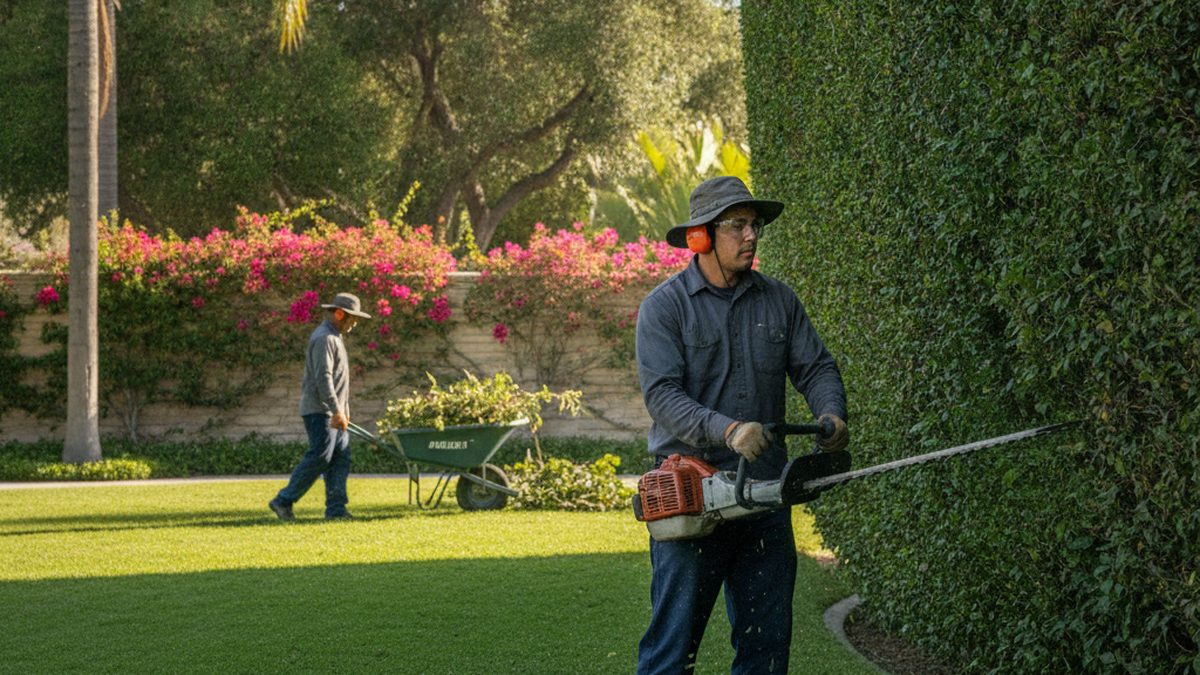
Landscaping looks simple from the street. A truck, a trailer, a crew, some mowers and blowers. From an insurance point of view, it is one of the more layered small businesses I work with in California.
Your crew works outdoors in heat, uses sharp power equipment all day, digs into ground that may hide gas lines, drives loaded trailers on the 405, and sometimes sprays chemicals on property that belongs to someone else. Every one of those activities touches a different policy, and every one of them has exclusions that catch people off guard.
This guide covers landscaping business insurance California owners actually need: workers’ comp, general liability, commercial auto, equipment coverage, and the special rules for tree work, pesticide application and licensed C-27 contractors. I am Shalom Samya, a licensed commercial insurance broker in Tarzana (CA DOI license #OK30674), and I write these policies for landscapers, gardeners and tree services across Los Angeles and the rest of the state.
Who This Guide Is For
“Landscaping” covers a lot of different businesses. Insurance carriers do not treat them the same, so the first step is being honest about what you really do.
- Maintenance gardeners and lawn care crews: mowing, edging, blowing, hedge trimming, seasonal cleanups on residential and commercial routes.
- Landscape installation contractors: planting, sod, grading, soil prep, drought-tolerant conversions.
- Hardscape contractors: pavers, retaining walls, patios, walkways, outdoor kitchens, fire features.
- Irrigation specialists: sprinkler and drip installation, controllers, repairs, water-efficiency retrofits.
- Tree services: pruning, removal, stump grinding, crane-assisted work, storm cleanup.
- Commercial grounds maintenance: HOAs, apartment complexes, office parks, retail centers, municipal contracts.
Many businesses do several of these. That is fine, but your application needs to say so. The most common problem I see with lawn care insurance California policies is a business rated as “mow and blow” that is quietly doing retaining walls, tree removal or herbicide spraying. When a claim comes in from the undisclosed work, the carrier has a strong argument to deny it.
Licensing Basics: CSLB C-27 and When It Applies
Before we talk about policies, it helps to understand the licensing picture, because your license status drives some of your insurance requirements.
The C-27 Landscaping Contractor license
The Contractors State License Board (CSLB) issues the C-27 Landscaping Contractor classification. It covers construction-type landscape work: installing irrigation systems, grading and drainage for landscaping, hardscape, planting, and related improvements.
California requires a contractor’s license for construction work once a job goes above the CSLB’s minor-work threshold for combined labor and materials. The exact dollar threshold has changed over the years, so check the current figure on the CSLB website rather than relying on what a friend told you in 2015.
Routine maintenance gardening, like mowing and pruning shrubs, is generally treated differently from construction-type landscape installation. If you are unsure which side of the line your work falls on, ask the CSLB directly. Unlicensed contracting problems can spill into insurance problems, because some policies and many contracts assume a valid license.
What the CSLB requires for C-27 landscaping contractor license insurance
Landscapers follow the same core rules as other licensed contractors:
- Workers’ compensation: if you have employees, you must have a current workers’ comp certificate on file with the CSLB. If you have no employees, you file an exemption. The CSLB has been expanding the list of classifications that must carry comp even without employees, so confirm the current rule for your classification at renewal time.
- Contractor license bond: $25,000, a figure that has applied since January 1, 2023.
- LLC requirements: if your license is held by an LLC, the CSLB has additional liability insurance and bond requirements. Confirm the current amounts with the board or with me before you apply.
The bond is not insurance for you. It protects consumers and workers if you fail to meet your obligations. I place these through our surety bond markets, and for most landscapers with decent credit the premium is modest.
Tree work has its own classification
If you do significant tree trimming and removal, the CSLB has a separate tree service specialty (D-49 under the C-61 limited specialty). Many landscapers hold both. From an insurance standpoint, tree work is rated very differently from lawn care, which I cover in detail below.
Coverage by Service Type
Here is how I think about the core coverages for different kinds of landscaping businesses. This is a starting point, not a quote. Your contracts, crew size and vehicles all change the picture.
| Service type |
Workers’ comp |
General liability focus |
Commercial auto |
Equipment / inland marine |
Watch for |
| Maintenance gardening / lawn care |
Required with any employee; landscape gardening class |
Flying debris, broken windows, car damage, slip-and-fall on client property |
Trucks and trailers used on routes |
Mowers, blowers, trimmers, trailers |
Undisclosed side work (trees, spraying, hardscape) |
| Landscape installation |
Required; payroll split by duties where allowed |
Property damage during grading and planting, drainage issues, completed operations |
Dump trucks, flatbeds, trailers |
Skid steers, mini excavators, trenchers |
Underground utility strikes; water intrusion claims |
| Hardscape |
Required; may rate closer to masonry or concrete work |
Completed operations (walls, patios), structural claims, settling |
Heavier trucks hauling stone and block |
Saws, compactors, loaders |
Retaining wall height limits and engineering exclusions |
| Irrigation |
Required |
Water damage to homes and foundations, utility strikes when trenching |
Service vans and pickups |
Trenchers, tools, parts inventory in vehicles |
Water damage sublimits or exclusions |
| Tree service |
Required; tree trimming class is one of the higher rated classes |
Falling limbs on homes, cars, power lines; neighbor property damage |
Bucket trucks, chip trucks, trailers |
Chippers, stump grinders, climbing gear, cranes (if owned) |
Tree work exclusions on standard landscaping GL; height limits |
| Commercial grounds / HOA contracts |
Required |
Higher limits, additional insured, primary and noncontributory wording |
Fleet of route trucks |
Large fleet of mowers and ride-ons |
Contract insurance requirements and certificate deadlines |
Now let’s go through each coverage in more detail.
Workers’ Compensation for Landscapers
Workers’ comp is usually the biggest insurance cost for a landscaping company with a crew. It is also the one you cannot skip.
The legal requirement
Under California Labor Code §3700, virtually every employer with even one employee must carry workers’ compensation. Operating without it is a crime. The Labor Commissioner can issue a stop order that shuts your business down on the spot, along with penalties.
This applies to part-time helpers, seasonal crews and family members on payroll, subject to limited exceptions. I cover the full rules on my California workers’ compensation page.
“They’re independent contractors” is not a plan
Landscaping is an industry where a lot of labor is paid by the day, in cash, or as “subs.” In California, calling someone an independent contractor does not make them one. Under the state’s ABC test, a worker who does the same kind of work your business does, under your direction, is very likely your employee.
If an unclassified helper gets hurt with a hedge trimmer, the claim can land on you. If you have no comp policy, you are uninsured. If you have a policy but did not report that payroll, the carrier will pick it up at audit and bill you for it. Either way, it costs more than doing it right from day one.
If you do use real subcontractors, get their certificates of insurance before they start work, keep them on file, and make sure they carry their own comp. At audit, uninsured subcontractor payments are commonly added to your payroll.
How landscaping comp is priced
California workers’ comp is priced per $100 of payroll by class code. The WCIRB publishes advisory pure premium rates for each class, and each carrier files its own rates on top of that. Once your premium passes the eligibility threshold, an experience modification factor based on your own claims history adjusts the price up or down.
Landscape gardening is typically rated under its own class (0042 in California), and tree pruning and trimming has a separate class (0106) that is generally rated much higher. Hardscape and irrigation work can end up in other construction classes depending on the duties. The class codes matter a lot, because putting a lawn crew in a tree class, or a tree crew in a lawn class, changes the premium dramatically, in one direction or the other.
Office staff and estimators who never go into the field usually belong in clerical or outside sales classes, which are far cheaper. If those people are lumped into the field class, you are overpaying.
Heat illness prevention and Cal/OSHA
Heat is a real safety issue for landscape crews, especially in the San Fernando Valley, the Inland Empire and the desert areas where summer temperatures go well past 100 degrees.
Cal/OSHA’s outdoor heat illness prevention standard requires employers with outdoor workers to provide:
- Enough fresh, cool drinking water for every worker throughout the shift.
- Shade when temperatures exceed 80°F, and access to shade on request at any temperature.
- High-heat procedures when temperatures reach 95°F, including closer observation and pre-shift meetings.
- Acclimatization for new workers and during heat waves.
- Training for workers and supervisors, and a written heat illness prevention plan, in a language your crew understands.
Cal/OSHA inspects landscapers, and the citations are not cheap. Beyond the fines, heat illness claims are expensive workers’ comp claims. A written plan and a crew that actually follows it help your experience mod over time, and underwriters do ask about safety programs.
Common landscaping injuries
The claims I see discussed most in this industry are the ones you would expect:
- Cuts and amputations from mowers, trimmers, chainsaws and hedge shears.
- Eye injuries from debris.
- Back and shoulder strains from lifting stone, sod, soil bags and equipment.
- Falls from ladders, trees and retaining walls.
- Heat illness and dehydration.
- Hearing loss from years of loud equipment.
- Chemical exposure for crews that apply pesticides or herbicides.
Personal protective equipment, simple lifting rules and equipment guards are not just paperwork. They are the fastest way to keep your comp rates from climbing.
General Liability: Flying Rocks, Broken Windows and Utility Strikes
Commercial general liability covers third-party bodily injury and property damage caused by your operations. For landscapers, this is the policy that responds when your work damages someone else’s property or injures someone who is not your employee.
Typical landscaping liability claims
- A string trimmer throws a rock through a sliding glass door or into a parked Tesla.
- A mower kicks debris into a pedestrian on the sidewalk.
- A client trips over a hose or tool your crew left on the walkway.
- Your crew cuts into a buried cable, gas line or irrigation main.
- A new irrigation line leaks against a foundation and water gets into the house.
- A retaining wall you built fails and damages the neighbor’s property.
- Grading work changes drainage and sends water into a garage.
Some of these are small claims you might pay yourself. Others, like a utility strike or a wall failure, can easily reach six figures.
Call 811 before you dig
California law requires anyone excavating to contact the regional notification center (811, which is DigAlert in Southern California) at least two working days before digging, so utilities can mark their lines. That includes trenching for irrigation, setting posts, and digging footings for walls and pavers.
From an insurance standpoint, failing to call 811 does not automatically void your GL policy, but it makes a utility strike claim much harder to defend. It can also expose you to penalties and to the full cost of repairs. Make “call 811 and keep the ticket number” a standard step on every job that involves digging.
Completed operations coverage
Hardscape, irrigation and installation contractors need to pay attention to completed operations. This covers claims that arise after the job is finished, like a paver patio that settles and causes a fall, or a wall that fails a year later.
Most GL policies include completed operations, but some cheaper policies limit it, and some contracts require you to keep it in force for years after a project closes. Read the requirement before you sign.
Care, custody and control
Standard GL excludes damage to property in your care, custody or control, and damage to “that particular part” of property you are working on. For landscapers, that can mean damage to the very lawn, tree or irrigation system you were hired to work on is not covered.
Some carriers offer limited endorsements that give back a slice of this coverage. It is worth asking about, especially for commercial grounds contracts.
Pesticide and Herbicide Application: The Exclusion That Surprises People
Many landscaping GL policies exclude, or severely limit, claims arising from pesticide and herbicide application. The standard pollution exclusion can also come into play when chemicals drift onto a neighbor’s garden, a pool or a child’s play area.
If your crew sprays weed killer, applies fertilizer with pest control products, or treats trees and shrubs, tell your broker. You may need a specific herbicide and pesticide applicator endorsement or a separate pollution policy. Some carriers will only write it if you hold the right state licensing.
California DPR licensing (keep it on your radar)
California’s Department of Pesticide Regulation (DPR) licenses businesses and individuals that apply pesticides for hire. Depending on what you do, that can mean a maintenance gardener pest control license for incidental applications on landscape maintenance jobs, or a full pest control business license, along with registration with the county agricultural commissioner where you work.
The categories and requirements are detailed, and I am not going to try to restate them here. Check with DPR and your county agricultural commissioner. What I will say is this: carriers ask about it, and unlicensed spraying is one of the easiest ways to end up with a denied claim.
Tree Service Insurance and Tree Trimming Exclusions
Tree service insurance is its own specialty, and it is the area where landscapers most often have a gap without knowing it.
Why carriers treat tree work differently
Tree work combines height, chainsaws, heavy falling objects and nearby property: houses, cars, fences, pools and power lines. Claims tend to be larger and more frequent than lawn care claims. That is why many landscaping GL policies include a tree trimming exclusion, or limit coverage to work performed from the ground or below a certain height (commonly something like 15 feet, though it varies by carrier).
If you take a job removing a large eucalyptus or pine in the hills of Encino or Topanga, and a limb comes down on the client’s roof, a landscaping policy with a tree exclusion or height limit may not respond at all.
What a tree service program usually looks like
- GL written for tree work, with explicit coverage for trimming and removal at the heights you actually work.
- Workers’ comp with climbers and ground crew properly classified. Tree trimming classes are among the more expensive in landscaping, which is exactly why misclassification is tempting and why auditors look for it.
- Commercial auto covering bucket trucks, chip trucks and trailers.
- Inland marine for chippers, stump grinders, aerial lifts and climbing gear.
- Crane and rigging considerations if you own or rent cranes, including who carries liability for the operator.
- Utility line exposure: work near energized lines has specific safety rules and can affect whether a carrier will write you at all.
If tree work is a small side part of your landscaping business, some carriers will add it with limits. If it is a real part of your revenue, you are usually better served by a program built for tree services. Either way, do not hide it.
Commercial Auto for Trucks and Trailers
Landscapers live in their trucks. Commercial auto insurance is not optional when you are using vehicles for business, and personal auto policies commonly exclude business use or deny claims when the vehicle was being used for work.
What to insure
- Pickups, stake beds, dump trucks and service vans owned by the business.
- Trailers, including the liability they create when attached to a truck and the physical damage to the trailer itself.
- Employees driving company vehicles, with a driver list and MVR checks.
- Hired and non-owned auto for when employees run errands in their own cars or you rent a truck.
Limits
California’s private passenger minimum auto liability rose to 30/60/15 on January 1, 2025. For a business, that minimum is not close to enough. A loaded landscaping truck and trailer rear-ending someone on the 101 can produce a claim far beyond those limits.
Many commercial and HOA contracts require $1,000,000 combined single limit on auto. I usually recommend that as a starting point for landscapers, with an umbrella policy above it once you have multiple trucks on the road.
Equipment in the truck
Commercial auto physical damage covers the vehicle, not the mowers and tools in the bed. If your truck is stolen from a job site in Van Nuys with $15,000 of equipment on the trailer, the auto policy handles the truck. The equipment needs its own coverage, which brings us to inland marine.
Protecting Mowers, Equipment and Tools
Landscaping equipment is expensive and easy to steal. A commercial zero-turn mower, a set of battery blowers and trimmers, and a trailer can add up quickly. California’s move away from new gas-powered small off-road engines has also pushed many crews toward battery equipment, and a full battery kit with spare packs is a real investment.
Equipment that travels from job to job is not properly covered by a standard property policy, which is written for property at a fixed location. That is what inland marine (contractor’s equipment or tools and equipment floaters) is for.
| Option |
What it covers |
Best for |
Things to check |
| Scheduled contractor’s equipment floater |
Specific listed items (by make, model, serial number) against theft and damage, on the road or on site |
Larger items: ride-on and zero-turn mowers, skid steers, chippers, stump grinders, trailers |
Keep the schedule updated when you buy or sell; confirm replacement cost vs. actual cash value |
| Unscheduled tools and equipment (blanket) |
Small tools and equipment up to a per-item and total limit |
Blowers, trimmers, hedge trimmers, hand tools, battery packs |
Per-item maximum (often a low figure); deductible relative to item value |
| Rented or leased equipment coverage |
Equipment you rent from a rental yard while in your care |
Occasional use of excavators, trenchers, aerial lifts |
Rental contracts may make you responsible for full value; compare to the rental yard’s damage waiver |
| Business property (BOP or commercial property) |
Property at your yard, shop or office: building contents, stored equipment, inventory |
Businesses with a yard or shop in the Valley or elsewhere |
Equipment off premises is usually limited; don’t rely on this alone |
| Trailer physical damage (on auto policy) |
The trailer itself |
Anyone towing enclosed or open trailers |
Contents of the trailer are not covered here |
| Theft protection conditions |
Not a coverage, but many policies require locked vehicles, locked trailers or visible signs of forced entry |
Everyone |
Unattended vehicle clauses can deny theft claims from unlocked trucks |
The biggest mistake I see with equipment coverage is an outdated schedule. You bought a new mower two years ago and never added it, or you sold the old one and are still paying for it. Once a year, walk your yard with your equipment list and update it.
Other Coverages Landscapers Should Consider
Umbrella or excess liability
An umbrella sits above your GL, auto and employer’s liability limits. For landscapers with multiple trucks, commercial contracts or tree work, it is often the most cost-effective way to meet a contract’s higher limit requirement and to protect against a serious accident.
Employment practices liability (EPLI)
Once you have a crew, you have employment risk: wage and hour disputes, wrongful termination, harassment claims. Under FEHA, most employment protections apply at five or more employees, and harassment protections apply to employers with one or more. Employers with five or more must provide sexual harassment prevention training. EPLI helps with defense costs on covered claims, though wage and hour claims are often limited or excluded.
Pollution liability
If you handle chemicals, fuel, fertilizer or do significant grading near waterways, a contractor’s pollution policy can fill gaps left by the pollution exclusion on your GL.
Faulty workmanship and professional exposure
Landscape design firms and design-build landscapers who draw plans can face claims based on the design itself, not just the installation. Standard GL is not written to cover professional errors. If you sell design services, talk to me about whether a professional liability policy makes sense.
What Contracts and Clients Typically Require
If you want HOA, property management, commercial, or municipal work in Los Angeles, the insurance requirements are part of the bid. I often see landscapers lose jobs, or get paid late, because their certificate did not match the contract.
Here is what shows up most often in landscaping contracts:
- General liability limits of $1,000,000 per occurrence and $2,000,000 aggregate, sometimes higher for large commercial properties.
- Commercial auto at $1,000,000 combined single limit, covering owned, hired and non-owned autos.
- Workers’ comp at statutory limits, with employer’s liability commonly at $1,000,000.
- Umbrella of $1,000,000 to $5,000,000 on larger contracts.
- Additional insured status for the property owner, HOA and management company, on both ongoing and completed operations.
- Primary and noncontributory wording, meaning your policy pays first and does not ask theirs to share.
- Waiver of subrogation on GL and workers’ comp, which means your carrier agrees not to pursue the client after paying a claim.
- Notice of cancellation provisions.
- Proof of license (C-27 and sometimes D-49) and, for spraying, proof of pesticide licensing.
Many of these are endorsements you add to your policy, sometimes for an additional charge. The time to find out is before you sign the contract, not when the property manager rejects your certificate on the first day.
My advice: when you receive a contract or RFP, send me the insurance section before you bid. I will tell you whether your current program meets it and what it would cost to close any gaps, so you can price your bid correctly.
Want a second set of eyes on your coverage? I offer a free coverage review for landscapers, gardeners and tree services. Call me at (323) 999-6067 or send a message here and I will go through your policies and contracts with you.
Landscaper Insurance in Los Angeles: Local Realities
Writing landscaper insurance Los Angeles businesses can rely on means paying attention to a few local factors.
Hillside and wildfire areas
Brush clearance and defensible space work in the Santa Monica Mountains, the Verdugos, and the foothills is steady business, but it involves steep terrain, heavy equipment and fire exposure. Tell your carrier if you do brush clearance, because some treat it differently from standard maintenance.
Theft
Equipment theft from trucks and trailers is common in LA. Carriers know it. Locked enclosed trailers, GPS trackers and parking in a secure yard overnight can make a difference in both your pricing and your ability to collect on a claim.
Traffic and long routes
Crews that run routes from the Valley to the Westside or down to the South Bay spend a lot of time on congested freeways. More miles and more time on the road means more auto exposure. Driver selection and training matter.
Water efficiency work
Drought-tolerant conversions, turf replacement and smart irrigation upgrades are a big part of Southern California landscaping. They often involve removing lawns, trenching and changing drainage. That increases both utility strike risk and water damage risk, so your GL should be written with that work in mind.
How Much Does Landscaping Insurance Cost in California?
I cannot give you a real price without the details, and anyone who quotes you over the phone without asking about payroll, class codes, vehicles and services is guessing.
Here is what I can tell you about how costs work. For a small maintenance gardener with no employees and one truck, total annual premium for GL and commercial auto may run in the low thousands of dollars. For a landscaping company with a crew, workers’ comp will usually be the largest line, and total insurance cost can reach the tens of thousands per year, or much more for tree services and larger commercial operators.
These are broad ranges. Actual costs vary by class code, payroll, revenue, location, vehicles, driving records, claims history, the services you perform and the carrier. I go into more detail on the factors in my article on how much business insurance costs.
Ways to keep premiums reasonable
- Classify payroll correctly, especially clerical and sales staff.
- Keep tree work, spraying and hardscape clearly described, so you are not charged for exposures you do not have, and not denied for ones you do.
- Get certificates from every subcontractor.
- Run MVRs on drivers and keep a clean driver list.
- Have a written heat illness prevention plan and a basic safety program.
- Report claims promptly. Late reporting makes claims more expensive.
- Update your equipment schedule every year.
- Shop the market at renewal through a broker with access to multiple carriers.
Common Mistakes I See with Landscaping Insurance
These come up again and again when I review landscaping programs.
Buying a policy that does not match the work
A cheap “lawn care” policy looks great until the claim involves a tree, a wall or a chemical. Read the description of operations on your policy. If it does not describe what you actually do, fix it.
Running without workers’ comp
Some small operators think a single helper does not count, or that paying cash avoids the issue. It does not. Section 3700 applies, and a single serious injury can put an uninsured landscaper out of business.
Relying on personal auto
Using a personal policy on a work truck is one of the easiest ways to have a claim denied. If the truck carries your equipment and goes to job sites, it needs commercial auto.
No coverage for equipment on the road
Many owners assume their mowers are covered because they have “business insurance.” Often they are not, or only at the shop. Inland marine solves this.
Signing contracts without reading the insurance section
Additional insured, waiver of subrogation and primary and noncontributory are not boilerplate. They change how your policy responds. Some carriers charge for them, and some contracts require things your policy cannot provide.
Not reviewing coverage as the business grows
You started with one truck and a route of residential clients. Now you have four trucks, two HOA contracts and a hardscape crew. The policy you bought five years ago was not built for this business. Review it at least once a year.
How I Work with Landscaping Businesses
My job is not to sell you the most policies. It is to understand how your business actually runs, match the coverage to that, and shop it across multiple carriers so you get a fair price.
For landscapers, that usually means:
- Walking through your services, crew, vehicles, equipment and contracts.
- Checking your class codes and payroll allocation for workers’ comp.
- Reviewing your GL for tree, pesticide, height and water damage exclusions.
- Building an equipment schedule you can actually maintain.
- Comparing contract requirements to your current policies.
- Shopping the market with carriers that want landscaping business.
- Being available when a claim happens or a property manager needs a certificate by tomorrow morning.
I have been a licensed producer since 2014, with more than 15 years in commercial insurance, and I work with clients in English, Hebrew and Spanish. Spanish matters in this industry: many crew leaders and owners are more comfortable walking through coverage and safety requirements in Spanish, and I am happy to do that.
If you also do broader construction work, my guide to contractor insurance in California covers the wider picture. For an overview of every major business policy, see my guide to commercial insurance in California.
Frequently Asked Questions
Do I need a C-27 license to do landscaping in California?
You generally need a CSLB license for construction-type landscape work above the board’s minor-work threshold, and the C-27 is the classification for that work. Routine maintenance gardening is typically treated differently. Check the current threshold and rules with the CSLB before you bid installation or hardscape jobs.
Do I need workers’ comp if I only have one helper?
Yes. Under Labor Code §3700, virtually every California employer with even one employee must carry workers’ comp. Part-time and cash-paid helpers usually count as employees. Going without it can lead to stop orders, penalties and personal liability for injuries.
Does my landscaping general liability cover tree removal?
Not always. Many landscaping GL policies exclude tree trimming or limit coverage to work below a certain height. If you do tree work, make sure it is disclosed and specifically covered, or consider a program designed for tree services.
Is pesticide or herbicide spraying covered?
Often it is excluded or limited unless you add a specific endorsement, and carriers may require proper California DPR licensing. Tell your broker if your crews apply any chemicals, even weed killer on a maintenance route.
Are my mowers and blowers covered by my business insurance?
Only if you have the right coverage. Commercial auto covers the truck, not the equipment in it. Equipment that moves between job sites is usually insured through an inland marine or contractor’s equipment floater.
What happens if my crew hits a gas line while digging?
Your general liability policy may cover third-party damage from a utility strike, subject to its terms. Always call 811 at least two working days before digging and keep the ticket number. Skipping that step makes the claim much harder to defend and can lead to penalties.
What insurance do HOAs and property managers usually require?
Commonly $1M/$2M general liability, $1M commercial auto, workers’ comp with employer’s liability, and often an umbrella. They typically want additional insured status, primary and noncontributory wording and waivers of subrogation. Check the contract before you bid.
How can I lower my landscaping insurance costs?
Classify payroll correctly, describe your operations accurately, collect subcontractor certificates, keep drivers clean, run a real safety and heat illness program, and have a broker shop your coverage across several carriers at renewal.
Ready to make sure your landscaping business is covered the right way? Call me at (323) 999-6067 or request a free coverage review. I will go through your policies, your contracts and your equipment, and tell you plainly where you are covered and where you are not.